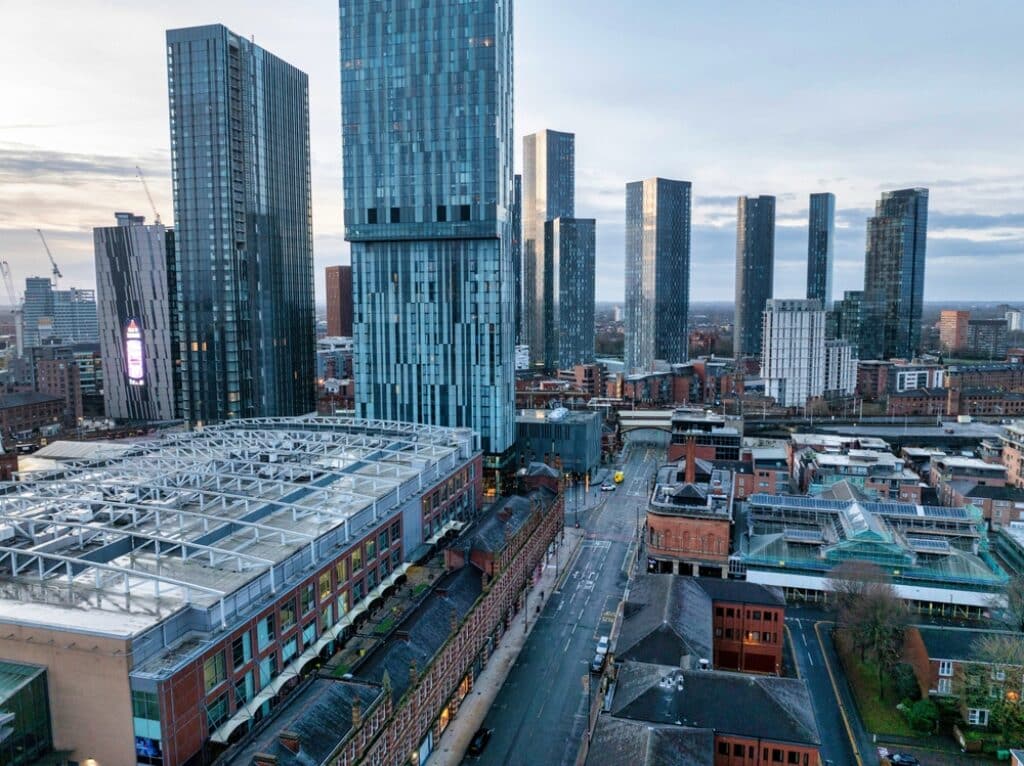

The average asking price for a home in Manchester is up by 63% compared with a decade ago, coming to £261,891. By contrast, prices in London are only up by 7%. Despite much slower house price inflation, the average asking price Londoners face is 162% higher than for Mancunians, at £687,080.
Furthermore, the four fastest growing local areas over the past 10 years – Levenshulme, Atherton, Droylsden and Failsworth – are all suburbs of Greater Manchester. House prices in these towns have all accelerated by around 80% over the past decade.
North versus South
The 10-year study carried out by Rightmove analysed millions of supply, demand and pricing data points to reveal a longer-term North versus South divide. Southern England’s cities make up none of the top 10 fastest growing cities for prices and half of the top 10 slowest growing cities for prices.
Wolverhampton, Newport and Nottingham are next on the list of cities that have seen the largest increase in prices over the last 10 years, with affordability a key driver of trends.

Your First Home: confidence to build
Sponsored by Halifax Intermediaries
Local property experts suggest growth, investment, affordability, transport links and lifestyle have all played a part in the Manchester success story.
The areas where prices have grown the least are also some of the most expensive overall, including London, Oxford, St Albans and Winchester.
Additionally, the data indicates there could be a spillover from some major cities into other cities nearby, driven by affordability. For example, from Manchester into Salford, Birmingham into Wolverhampton or Leeds into Wakefield and Bradford. Prices in these ‘spillover’ cities are all lower than their counterparts.
Affordability shaping trends
Colleen Babcock, Rightmove’s property expert said: “Looking at the bigger picture, affordability has been a central theme shaping these trends. Areas with lower starting price points have had more room for growth, which has contributed to a widening North/South divide in price growth trends over the last 10 years.
“Some of the shifts behind this are continuing to play out, particularly changes in working patterns. Greater flexibility through hybrid and remote working is still influencing where people choose to live, supporting demand in cities that offer better value and a different lifestyle balance.”
Cities with the fastest 10-year price growth
|
City |
Average price 2026 |
10-year price change |
|
Manchester |
£261,891 |
+63% |
|
Wolverhampton |
£229,094 |
+63% |
|
Newport |
£235,275 |
+57% |
|
Nottingham |
£210,238 |
+53% |
|
Wakefield |
£231,581 |
+52% |
|
Salford |
£226,559 |
+52% |
|
Bradford |
£171,282 |
+51% |
|
Stoke-on-Trent |
£174,850 |
+49% |
|
Doncaster |
£186,378 |
+49% |
|
Swansea |
£215,866 |
+48% |