
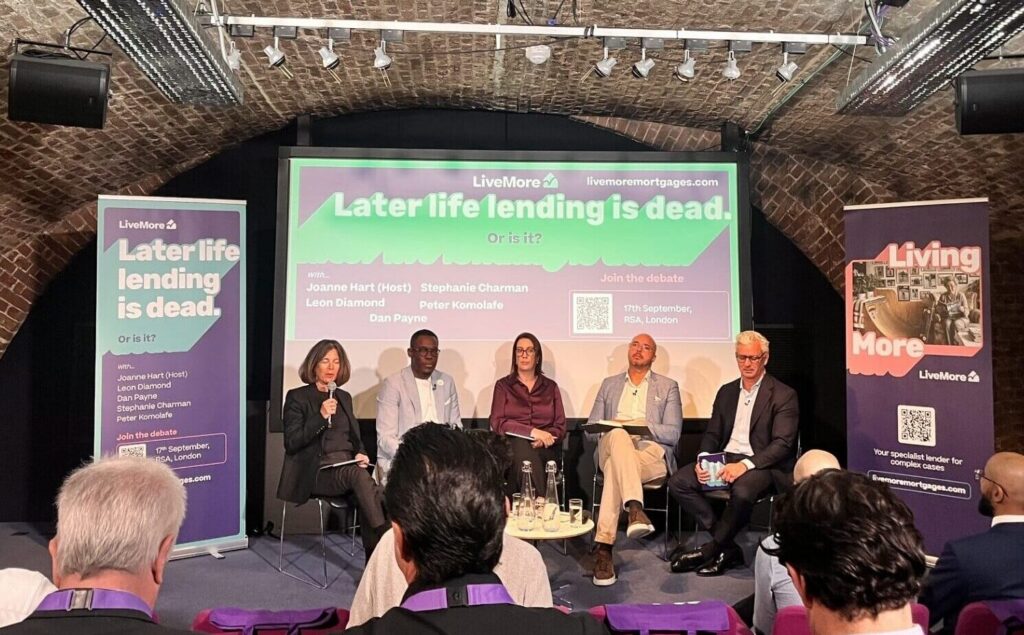

Stephanie Charman, chief executive of the Association of Mortgage Intermediaries (AMI), described a “cavern” between mainstream and later life lending, and called for the industry to close the gap between the two sectors.
“The two markets have become unnecessarily siloed and [a] warning that borrowers are missing out on more holistic advice as a result.”
“We need to bring the two markets closer together,” she said.
The discussion centred on how changing demographics, longer working lives and affordability pressures are reshaping borrowing patterns, leading some panellists to question whether the term ‘later life lending’ remains fit for purpose.
Leon Diamond, chief executive of LiveMore, argued that the label no longer reflects the reality of modern borrowing.

Episode 4: New Build: Powered by Partnership podcast from Newcastle for Intermediaries
Sponsored by Newcastle for Intermediaries
“Get rid of the acronyms,” he said, referring to products such as retirement interest-only (RIO) mortgages, term interest-only (TIO) mortgages and equity release, and arguing that the terminology can make later life lending harder to understand for borrowers.
Diamond questioned why borrowing beyond the age of 50 or 55 should automatically be viewed as a specialist category when people are living and working for longer than previous generations. Instead, he suggested lenders and advisers should focus on borrowers’ life stages and circumstances rather than their age.
Several advisers echoed the sentiment, proposing that consumers no longer view their 50s as ‘old’ and that the terminology itself can create barriers by making people feel excluded from mainstream mortgage options.
Borrowing into retirement
The conversation also highlighted how longer mortgage terms have become increasingly common, driven largely by affordability pressures.
Panellists noted that first-time buyers are entering the housing market later in life, more borrowers are opting for 35-year mortgage terms, and homemovers are increasingly extending borrowing into retirement.
Charman pointed out that a first-time buyer taking out a 35-year mortgage at age 35 effectively becomes a later life borrower from the moment the loan is completed.
The panel also debated whether the growing proportion of mortgages extending into retirement should be viewed as a cause for concern. While around 40% of mortgages now run beyond retirement age, none of the speakers described the trend as a crisis.
Charman suggested the market was in a period of transition.
“It’s not a crisis, not adaptation,” she said.
Dan Payne of L&C described the shift as a warning sign rather than a point of alarm.
“It’s an adaptation, a shift in the market, but we’re not at crisis yet,” he said.
Need for holistic advice
A recurring criticism throughout the discussion was the lack of truly holistic advice available to borrowers.
Several speakers argued that consumers often find themselves funnelled into one of two distinct advice channels: mainstream mortgage advice or equity release advice.
They suggested many borrowers sit somewhere between the two, but struggle to access guidance that considers the full range of available options.
Instead, borrowers can be directed down a particular route depending on which adviser they happen to approach, rather than receiving advice based on their broader financial circumstances.
Charman said a holistic advice approach would be key to addressing the issue, with advisers encouraged to consider clients’ long-term plans, retirement income and future borrowing needs rather than focusing solely on the immediate mortgage transaction.
One audience member argued advisers do not need to be experts in every area, but should know when to refer clients to a specialist.
“It’s not about knowing everything, but knowing who to pass on to,” they said.
The panel also discussed the emotional aspects of later life lending, with some speakers suggesting borrowers often approach the market carrying a sense of stigma.
One adviser said many clients view the need to consider later life borrowing solutions as a personal failure, despite often holding significant housing wealth.
He said: “They’re carrying all this inhibition.
“I speak to a lot of clients who consider themselves a failure because they have to consider later life lending. The wealth is there, it’s just not in the right format.”
The discussion concluded with a broad consensus that changing borrowing patterns, housing affordability challenges and longer working lives are blurring the boundaries between mainstream and later life lending.
It creates a stronger case for joined-up advice and a rethink of how the sector is defined.