
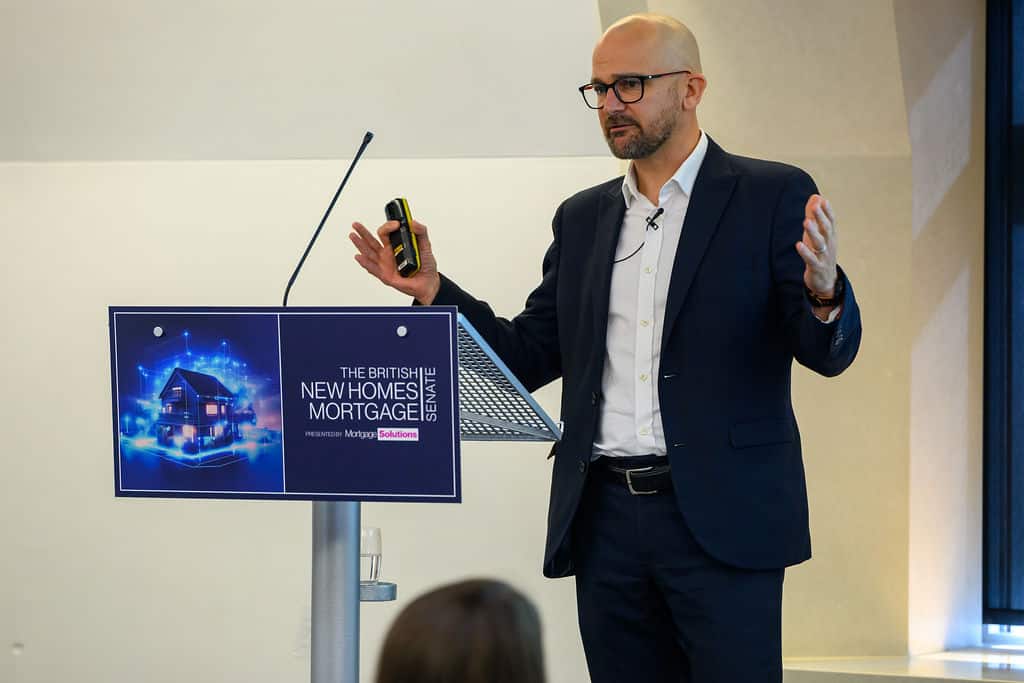

Richard Lankshear, director of the Future Homes Hub, spoke at Mortgage Solutions’ British New Homes Mortgage Senate and said it was “really difficult to get any sensible numbers” out of what the potential cost of building homes to the Future Homes Standard would be for developers.
He said homebuilders had regulatory and building costs to contend with and the Future Homes Standard added to this.
The Future Homes Standard, which requires new dwellings to be energy efficient, will be fully implemented by 2028.
The policy will require new homes to have low-carbon heating, such as heat pumps and heat networks, and on-site renewable electricity generators, such as photovoltaic (PV) solar panels.
Lankshear said: “The government itself put out an assessment… [predicting a cost of] £5-6,000 per plot… when you speak to different developers, the numbers can be slightly lower, but more often, reported as significantly higher.”

Episode 4: New Build: Powered by Partnership podcast from Newcastle for Intermediaries
Sponsored by Newcastle for Intermediaries
Referencing Conservative leader Kemi Badenoch’s pledge to get rid of the Future Homes Standard at the party’s conference, Lankshear said this made the situation “really frustrating”, as there was no consistency or political consensus around longer-term planning for the property market.
“Even recent discussions around that, when people ask, ‘Will they? Won’t they?’, that’s going to have an instant knock-on effect along the supply chain,” Lankshear said, adding that the sector wanted long-term consistency.
The Future Homes Standard is expected to benefit consumers by lowering the cost of running a home, with the government calculating savings of around £850 on homes powered by electricity.
However, Lankshear said there were “too many variables” to fully compare the running cost of a home fuelled by electricity rather than gas. “In some cases, it’s a little more expensive [because of] electricity prices… in some places, less so,” he added.
Lankshear said this was similar to the consideration when choosing an electric car, as savings were often realised through time-of-use tariffs, where costs fluctuate during the day.
Aligning with EPC reform
The introduction of the Future Homes Standard will follow reforms to Energy Performance Certificates (EPCs), due in 2027.
The new EPC will be based on four metrics: energy cost, fabric performance, the heating system and smart readiness, and which technologies are in a home.
Lankshear said the Future Homes Hub was still in discussions with government regarding the new EPC and how it might line up with the demands of the Future Homes Standard.
For example, if a developer does not meet the 40% minimum PV coverage on a home but is exempted from this obligation, it might be rated down, which Lankshear said would be “daft”.
How will homes be valued?
“The homes we’re building are changing dramatically and it’s not just because we’re going to heat pumps and PV,” Lankshear said, adding that the organisation was carrying out a suite of work with developers, the government, the supply chain and the financial services sector.
Lankshear said the Future Homes Hub was currently viewing the valuations process, particularly as there had been “really rapid change in the way homes are perceived” and Part L 2021, which laid the foundations for the Future Homes Standard, had resulted in a “fundamental change” for homeowners.
He added: “If we waited for all of these homes to be built in five years or so, until we get good data out of the sales price, we can’t actually understand what is the true valuation of these homes now.”
The Future Homes Hub is running a pilot scheme with a valuation lending group, looking at a suite of homes built to the equivalent of the Future Homes Standard. They will be sharing the information with surveying firms and banks to understand how they might be valued now, with a view to following up with site visits.
This will be tested by the valuation group and potentially shared with the industry in due course.
Read more coverage from this year’s British New Homes Mortgage Senate:
- British New Homes Mortgage Senate: Lenders assess what’s holding back homeownership
- British New Homes Mortgage Senate: New-build premiums are real, but benefits must be explained
- British New Homes Mortgage Senate: Brokers and developers should take longer-term view of buyer journeys
- British New Homes Mortgage Senate: The economics of housebuilding have changed since Help to Buy