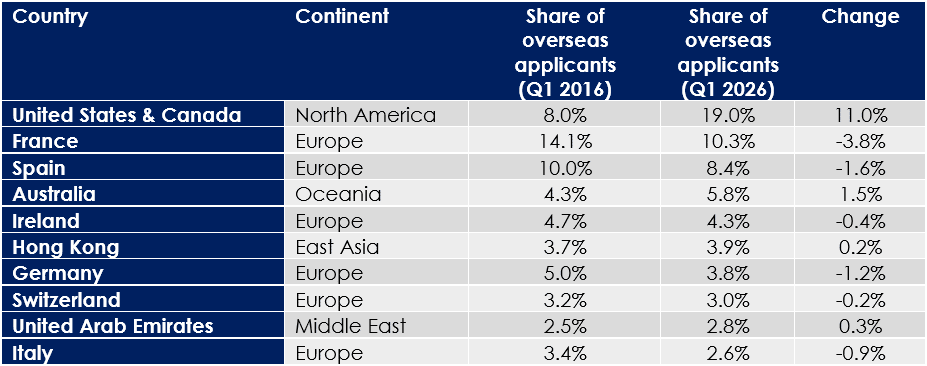
Analysis of Connell Group buyer registration data by Hamptons showed that the proportion of demand from North America, including buyers from the US and Canada, was 4% up on last year and 11% higher than a decade ago.
This resulted from a 13% increase in North Americans registering to buy property in Great Britain in Q1 compared to last year, despite a 10% overall drop in international registrations. Hamptons said this reflected how UK property continued to be seen as good value.
Buyers from Europe still represent the largest group of overseas demand, accounting for 54% of international applicants. Hamptons said this was relatively flat over the last year, but due to Brexit, the share had fallen by eight percentage points over the last decade.
This decline has been driven by reduced demand from French and Spanish buyers, who made up a larger share of international applicants 10 years ago. By contrast, demand from North American buyers has more than doubled over the same period.


Episode 4: New Build: Powered by Partnership podcast from Newcastle for Intermediaries
Sponsored by Newcastle for Intermediaries
Source: Hamptons
Middle Eastern demand fails to recover
Hamptons found that interest from buyers in the Middle East was just 5% in Q1 this year, the lowest share seen since 2013 and a 1% fall on last year.
Buyer registrations from the Middle East fell sharply after the war broke out, dropped 27% month-on-month in March and 58% lower than the same month a year earlier.
Hamptons said this pointed to caution around new purchases, with Middle Eastern households choosing to hold onto their existing homes in the UK, rent as a stopgap or base themselves in other countries.
Source: Hamptons
London property seen as better value
London was the only region to see a rise in interest from overseas buyers in Q1, with an 8% annual increase in registrations.
A quarter of all international demand was for property in London, up from 21% a year ago and the largest annual increase out of any region in the UK.
Hamptons said this was against a backdrop of muted price growth in London, making properties seem better value.
Property in the capital is 3% or £18,000 cheaper than in 2022, while values in Inner London are 7% or £50,300 down.
Some 28% of North Americans were seeking property in London, up from 24% last year and 17% in 2021.
Outside of London, international demand fell across every region, with a 26% decline in Scotland, a 27% drop in Wales and a 20% fall in the South West.
Buyers looking to relocate, not invest
Hamptons said there was more demand from people looking to buy homes to live in rather than invest, with the share of overseas applicants looking for a buy-to-let (BTL) property falling from 17% to 12% over the decade. Further, the share of people looking for a second home more than halved from 6% to 2%.
The firm said this was likely due to stamp duty surcharges and tax changes for overseas landlords.
This coincided with first-time buyers making up 23% of all international applicants in Q1, nearly triple the share seen 10 years ago.
This included 27% of North American first-time buyers, and 10% from the region seeking an investment property.
Younger movers shifting the trend
Aneisha Beveridge, head of research at Hamptons, said although international buyer demand had eased overall, Americans were “bucking that trend”.
She added: “For many, London is starting to look like relatively good value again, and we’re increasingly seeing people buying with a view to living here, not just investing.
“That shift is most obvious among younger movers. More overseas-based buyers are seeing London as a place to put down roots, including purchasing a first home, rather than a short‑term investment.”
Beveridge said the slowdown in international demand “largely reflects higher stamp duty costs and a tougher tax backdrop, particularly for overseas investors”.
She added: “An international buyer purchasing a £1m home in England would now face a stamp duty bill of £63,750, rising to £113,750 if they were buying a second home or a BTL. Even as rental yields improve, those upfront costs are becoming harder to justify, pushing investment elsewhere.
“In the past, strong price growth, especially in London, helped offset those costs. Today, however, with weaker or falling prices across parts of the capital, many international households relocating there are choosing to rent instead. But even so, London continues to stand out as a compelling destination, with its culture, lifestyle and world‑class education drawing people here for more than just financial reasons.”